Why More Agent Transparency Isn't Always Better
Transparency isn't a scalar — it's a matrix of "audience × granularity × delivery path." Show it to the wrong audience, and transparency turns into negative value.
Setting the target: a product buzzword held hostage by "political correctness"
Nearly every Agent product writes "transparency" into its value proposition: let users see what the AI is doing. Sounds beyond reproach — yet once it ships, the most common failure comes precisely from doing too much:
- Dumping a 5,000-word raw reasoning chain on the user, who only thinks "what on earth is this thing mumbling about";
- Popping a bubble for every tool call — "searching… opening… analyzing paragraph 1…" — until the user wants to shout "can you shut up and just show me the result";
- Tacking "I'm 85% confident" onto every sentence, except this number was never calibrated, so after a few misses the user stops trusting any confidence figure at all.
So what this lecture tackles isn't "should we be transparent," but a harder question: what exactly is transparency, for whom, and at what granularity. We're upgrading it from a fuzzy, gut-feel product word into a capability dimension that can be decomposed, instrumented, and given a KPI.
Framework 1: First, separate four concepts that look alike
Conflating "transparency / explainability / observability / auditability" is the earliest pit people fall into during interviews and reviews. They target different audiences and answer different questions:
| Concept | Audience | Question it answers | Timing |
|---|---|---|---|
| Transparency | End user | What is the Agent doing right now / on what basis | Runtime |
| Explainability | Business / Legal | Why did the model reach this conclusion | Mostly offline |
| Observability | PM / Engineering / SRE | Is the system healthy now, where's the problem | All the time |
| Auditability | Compliance / Regulators | Can we trace every step after the fact, who authorized what | After the fact |
A one-line anchor:
Transparency answers "can the user see it," observability answers "can the PM see it," explainability answers "why was it done this way," auditability answers "can it be traced after the fact." Different audiences, different UIs, different KPIs — you can't cram them into one metric.
Framework 2: Transparency's own three-layer MECE
Slice transparency by "who looks + at what granularity," and it splits orthogonally into three layers that are mutually independent and non-substitutable:
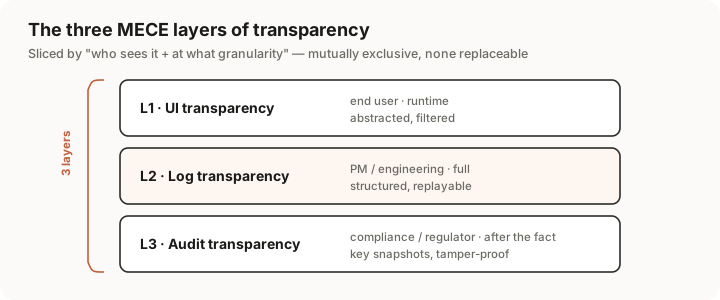
| Layer | Who looks | Content granularity | Timing | Tamperable |
|---|---|---|---|---|
| L1 UI transparency | End user | Abstracted, filtered | Runtime (synchronous) | N/A (one-off presentation) |
| L2 log transparency | PM / Engineering | Full, structured | Runtime (asynchronous to store) | Overwritable |
| L3 audit transparency | Compliance / Regulators | Snapshots of key decisions | Queried after the fact | Tamper-proof (append-only) |
The three layers form a Cartesian product: combinations like "UI exposed + logs missing + audit complete" can all occur, and each maps to a real-world scenario or an anti-pattern.
Data and anti-patterns: five crash sites of over-transparency
Knowing "what's wrong" is more useful than knowing "what's right." The following five anti-patterns cover ninety percent of over-transparency failures:
- Dumping the raw reasoning chain—the reasoning chain exists for the model to ground itself; it's full of backtracking and self-correction, and exposing it to the user only shows them "wrong intermediate steps" and erodes trust. The fix: collapse by default, show a conclusion summary, send the raw text to the log layer.
- A bubble for every tool call—the user doesn't need to know the name of each step, just that things are moving along overall. The fix: aggregate to stage-level granularity, "analyzing (1/4)."
- Treating uncertainty as a sales pitch—an uncalibrated "85% confident" is worse than "for reference only," because it sets up an expectation that is guaranteed to be broken. The fix: start with discrete levels, and only give numbers once calibrated.
- UI transparent, logs missing (a show for the user)—a pretty "thinking process" animation in the UI, but when something goes wrong you can't find that step in the logs. The fix: L1 must be derived from L2 — randomly sample 50 UI prompts against the logs, and they should be 100% reconstructable.
- Audit logs that can be overwritten—an overwritable log is no log at all. The fix: make the audit layer append-only (append-only / WORM), freeze key fields, and degrade the task if a write fails.
Framework 3: Business context can flip the priority
Transparency isn't "more is better" — it depends on the context. It's isomorphic to recall vs. precision: the same dimension flips priority across different businesses:
| Scenario | UI transparency | Core reason |
|---|---|---|
| High-risk / Medical / Legal | Very high | Users must see the reasoning to trust it, and it must be reviewable afterward |
| High-efficiency / Customer-service FAQ | Low | Concise > transparent; over-exposure is just noise |
| Creative / Writing tools | Low | "Black box that delights you" is itself the product value |
| Children / Vulnerable groups | Very high | Regulation + ethics require disclosing the AI's identity |
The judgment formula:
UI transparency priority = transparency benefit (trust + correction + compliance) ÷ transparency cost (attention + latency + exposed fragility + UI complexity). High-risk, low-frequency, high-ticket → must be transparent; low-risk, high-frequency, low-ticket → concise first.
A case: a contract-review Agent returns a "medium risk" conclusion
The same conclusion has to serve three audiences at three granularities:
- The lawyer (professional user): can see each risk point's five-tuple — clause reference + original text + AI analysis + confidence + revision suggestion; reasoning is collapsed by default, and clicking it open reveals a 200-word distilled version, not the raw text.
- The client company (non-professional): gets only a one-line conclusion + 3-5 key risks, and never sees the AI's confidence — telling the client "the AI isn't sure" is handing them a knife to refuse payment.
- Compliance (after the fact): tamper-proof retention of model_version / prompt_hash / retrieved snippets / manual edits, with TTL aligned to the legal retention period.
This leads to the most critical mindset upgrade in this lecture: there are more than three transparency audiences. Beyond the users you serve and the regulators you must clear yourself before, there's a fourth class — the adversarial third party that will use the information to make decisions against the user (e.g., an insurer denying coverage based on an undiagnosed probability). The correct transparency value for them is 0 — complete isolation.
Actionable practice: design transparency as a matrix
- To decide the layer, first ask two things: who's looking, and what for. The medium (dashboard / log) and field names (timestamp / version number) count for nothing.
- For sensitive signals about the end user (age / health / gender), the direction forks: the more sensitive, the more you hide it from the consumer side until only the behavior shows through, and the more completely you keep it on record for compliance to prove you don't discriminate. Hiding it at both ends = offending the user AND failing to clear yourself of discrimination.
- "Exposure" isn't a binary switch, it's three granularity tiers: raw values for PMs and compliance, processed conclusions for the business, pure behavioral manifestation for the end user.
- Retries and model degradation are not disclosed to the user (disclosing only causes anxiety); capability degradation, graceful failure, human handoff, and rollbacks with side effects must be disclosed.
Closing
Transparency isn't a scalar, it's a matrix of "audience × granularity × delivery path." For the doctor it's a decision input, for the patient it must be relayed through a human, for the insurer it must be zero, for the regulator it must be tamper-proof on record. Show it to the wrong audience, and transparency turns into negative value.