Why You Should Pick an Agent Framework Based on Need, Not Default to LangGraph
A decision tree and trade-off table that make clear when to reach for LangGraph / Checkpoint / Map-Reduce / Multi-Agent—and when not to.
Setting the target: both picking the wrong framework and adopting one too early are expensive
Let's start with a common scenario. A team sets out to build "automated document review," and in the very first week they wire up the full stack: LangGraph, a vector store, multi-agent orchestration. Two weeks later they realize the thing actually blocking progress isn't orchestration at all—it's that the prompts aren't tuned yet and single-step output still isn't stable. They paid the cost of framework complexity up front, while the business value stays out of reach.
Three hidden costs of adopting a framework too early:
- The abstraction hides observability. The framework packs "call the model → parse → route" into a black box, so when a step gets slow or its output goes bad, you can't see it. The first principle of Agent debugging is that "every step's I/O, latency, and tokens must be visible"—install the framework too early and you've already lost that.
- Complexity mismatch. A requirement that is fundamentally "single-step Q&A" gets wrapped in a node graph, a state machine, and Checkpoints, multiplying maintenance cost several times over—when it doesn't need conditional flow at all.
- Lock-in cost. Once a framework's core abstractions seep into your business code, switching frameworks means a rewrite.
But the reverse is also costly: choosing "no framework" can be just as wrong. For a production task that genuinely has complex conditional branches, needs resume-from-checkpoint, and needs human-in-the-loop (HITL), forcing it through a bare SDK with hand-rolled state management eventually produces a worse, less maintainable "homemade LangGraph."
So the target of this lecture isn't "is the framework good or not," but rather: where exactly on the complexity spectrum does your requirement sit, and what is the matching tool.
Frameworks: the capabilities and trade-offs of four classes of tools
The common options aren't four parallel brands—they're tools covering different tiers of the "complexity spectrum."
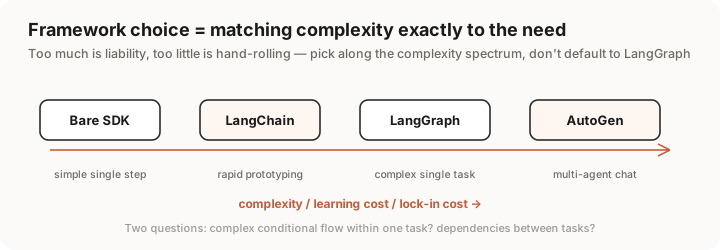
| Framework | Core abstraction | Where it fits | Trade-off |
|---|---|---|---|
| Bare SDK | None (you call the model yourself) | Simple single-step Agent | Most transparent, most controllable; but you hand-roll all complex flow |
| LangChain | Chain / Agent / Memory | Rapid prototyping | Quick to start, many components; abstraction is on the heavy side, production observability needs extra work |
| LangGraph | Node graph (Node + Edge + State) | Production-grade complex single-task Agent | Explicit state machine, supports Checkpoint; steep learning curve, overkill for simple tasks |
| AutoGen | Multi-Agent conversation | Agents need to discuss with each other | Good for collaborative reasoning; high communication overhead, results hard to control |
The essential difference between their core abstractions: the bare SDK has no state machine, LangGraph makes the state machine explicit, and AutoGen treats "the conversation among multiple Agents" as a first-class citizen. Framework selection is just judging which layer your requirement needs made explicit.
Around the LangGraph layer, there are three "capabilities" you must understand (they determine production-readiness; they aren't separate frameworks):
| Capability | What problem it solves | When you need it |
|---|---|---|
| State / Node / Edge trio | Explicitly model a complex flow as a shared dict + function nodes + fixed/conditional edges | When there are conditional branches inside a single task |
| Checkpoint (state persistence) | Don't rerun from scratch on mid-way failure; supports HITL, audit trail, resume-from-checkpoint | When the task is long, needs human intervention, or needs traceability |
| Map-Reduce | Split a big task into N parallel subtasks, then aggregate | When subtasks have no dependencies and you want to compress runtime |
Checkpoint's three storage backends escalate with deployment scale—don't reach for the heaviest one right away: MemorySaver (dev and debugging only) → SqliteSaver (single-machine production) → PostgresSaver (distributed).
Case: the evolution path of a contract review task
Requirement: review commercial contracts, identify risky clauses, and hand high-risk ones to a human for review.
Version 1 (a single contract) has the right shape of a LangGraph node graph, because internally it genuinely has conditional branches:
[input] → [parse] → Checkpoint
       → [Map: parallel review ×4 (payment / breach / confidentiality / disputes)] → individual Checkpoints
       → [Reduce: aggregate and dedupe] → Checkpoint
       → conditional edge: high risk?
           yes → [HITL Node] ← Checkpoint persistent wait
           no → [report generation] → [output]
Each capability maps to a real need: the four review dimensions have no data dependency on one another, so they go through Map-Reduce parallelism, cutting runtime from 4x down to roughly 1x; the task chain is long, so every step writes a Checkpoint and a failure doesn't force a rerun from scratch; high risk needs a human, so we use a conditional edge + HITL Node, relying on Checkpoint to persistently suspend state and resume once the person returns.
Version 2 (1,000 independent contracts) is a high-frequency pitfall. The intuition is "just orchestrate the batch processing into LangGraph too," but that's wrong. The 1,000 contracts are independent of one another; there's no conditional flow. The real bottleneck is concurrency control and failure retries, not the state machine. The right shape is layered:
Outer: asyncio controls concurrency (guard against API rate limits) + task queue
Inner: each contract still uses LangGraph to handle its own single-task flow
Global: support resume-from-checkpoint + independent retry per failed contract
In one line: "complexity inside a single task" is solved with LangGraph; "batching and concurrency across tasks" is solved with queues and async—don't conflate the two.
Only if this escalates further to "multiple Agents discussing and adjudicating the risk level among themselves" does it become time to consider multi-Agent conversation frameworks like AutoGen. And multi-Agent isn't free—it amounts to stacking another layer on top of the full single-Agent capability set:
Single Agent  = Tool Use + Context management + HITL + safety + idempotency + error retry
Multi-Agent = Single Agent × N + state persistence + three-tier error handling + parallel optimization + communication protocol + Orchestrator
Once you see this chain of plus signs clearly, you won't casually reach for multi-Agent just because it "sounds advanced."
Actionable approach: a selection decision tree + an engineering checklist
Step 1: run through the selection decision tree.
Q1: Does a single task have complex conditional flow inside it (branches / loops / human intervention)?
    yes → LangGraph     no → bare SDK
Q2: Are there dependencies among multiple tasks?
    dependencies → coordinate with an Orchestrator
    no dependencies → parallel batch processing (asyncio + queue), don't cram it into LangGraph
Step 2: confirm whether you actually need these three capabilities—adopt only when you need them, don't prepay.
- Task chain is long, may fail mid-way / needs audit / needs resume-from-checkpoint → add Checkpoint (MemorySaver for dev, Sqlite for single-machine, Postgres only when distributed)
- N mutually independent subtasks and you want to compress runtime → add Map-Reduce
- Need a human gate to release → add a HITL Node, relying on Checkpoint for persistent suspension
Step 3: if you decide to wrap a framework, hold to three principles.
- Only wrap the stable parts (prompts change often—don't wrap them in)
- The wrapper must not hide observability (every step's I/O / latency / tokens must be visible)
- Use an isolation layer to guard against abstraction leakage (your own interface → adapter → framework, so switching frameworks doesn't touch business code)
Step 4: the moment you go Multi-Agent, this "four-piece set" is the engineering baseline—miss one and you'll crash in production.
- Three-tier error handling: automatic retry (exponential backoff, 2-3 times) → graceful degradation → escalate to a human
- Idempotency: bind write operations to a unique operation ID, and check before executing whether it has already run (single Agents need this too)
- State persistence: write each step's result to storage (associated with a pipeline_id), and resume from checkpoint on restart
- Parallel optimization: data dependencies go sequential; only run in parallel when there are no dependencies
Wrap-up
First ask "which layer is my complexity at," then decide "whether to adopt a framework, and which layer of capability to adopt"; hand the complexity inside a single task to LangGraph, hand the batching across tasks to a queue, and the advanced-sounding multi-Agent is always the last card you play. One degree too much is a liability; one degree too little is hand-rolling.