"Learning & Adaptation + RAG: So Your Agent Stops Starting From Scratch — and Stops Making Things Up"
Learning lets an Agent improve its strategy from feedback; RAG lets it plug into your private knowledge — both work at the context layer.
Setting the Target: Two Flaws That Keep Your Agent From Ever Growing Up
Start with two real scenarios.
First: you give the Agent a data-cleaning task, and the first time it gets the date format wrong. You correct it. The next day, same task — it makes the same mistake, in the same spot. The day after, again. It isn't dumb; it simply has no learning mechanism. Every conversation is a blank slate, so the pit it fell into yesterday it falls into again today. Correct it a hundred times and nothing sticks. This is "starting from scratch every time."
Second: you ask the Agent, "In our company's expense policy, above what amount does a flight require second-level approval?" It hands you an answer that looks supremely confident, neatly formatted, even with a specific number. The problem is — it made that number up. It has never seen your company's expense handbook, but it won't say "I don't know." It will stitch together something that looks like the most expense-policy-shaped thing in its training data. This is "without RAG, all it can do is make things up."
These two flaws map to the two blind-spot patterns this lecture fills in: Learning and Adaptation solves "starting from scratch every time," letting the Agent improve its strategy from interactions and feedback; Retrieval (RAG) solves "making things up," letting the Agent look up your private knowledge before generating. They look like two separate things, but at the core they're the same problem: the model's weights are frozen and its knowledge has a cutoff — so how do you make a "frozen brain" behave as if it's continuously growing, and as if it knows things it originally didn't? The answer in neither case is to change the weights (too heavy). It's to change the context it receives each time — a thread that runs through this whole lecture.
Framework One: The Three Paths of Learning & Adaptation
"Letting an Agent learn" isn't a single action — it's three paths with completely different costs and payoffs. Remember one line first: the further down you go, the heavier it gets, but the more durable it is.
| Path | What changes | How | Durability | Cost | Typical scenario |
|---|---|---|---|---|---|
| ① In-context learning | No weight change, only context | Put experience/examples/corrections into the prompt or conversation history | Current session only | Very low | Few-shot examples; paste the error back and let it fix |
| ② Memory-driven adaptation | No weight change; change external memory | Write successful cases/user preferences into long-term memory, recall by relevance next time | Persistent across sessions | Medium | Remember "this user wants ISO 8601 dates," apply it automatically next time |
| ③ Fine-tuning / RLHF | Change the weights | Retrain on labeled data / reinforcement learning from human preferences | Permanent | High (iteration measured in weeks) | Burn stable domain-specific behavior into the model |
The three paths form a staircase, not a pick-one. The vast majority of Agent products rely on ① and ②, and almost never touch ③: both ① and ② change only the context, can be adjusted any time, and take effect the same day; ③ once burned into the weights is hard to undo and slow to iterate. Default engineering order: if in-context can solve it, don't reach for memory; if memory can solve it, don't reach for fine-tuning.
One key distinction — explicit vs. implicit feedback: explicit feedback is the user telling you outright what's right or wrong (strong signal, low noise — store it in memory with high weight); implicit feedback is inferred from behavior (copying your output = useful; rewriting it immediately = missed the mark; asking three times = didn't hit the point — weak signal but high volume, and it doesn't bother the user). A mature learning Agent uses both. The most common rookie mistake is wiring up only explicit feedback — but users rarely correct you proactively, and most of the valuable signal is hidden in behavior.
Framework Two: The Five Steps of RAG
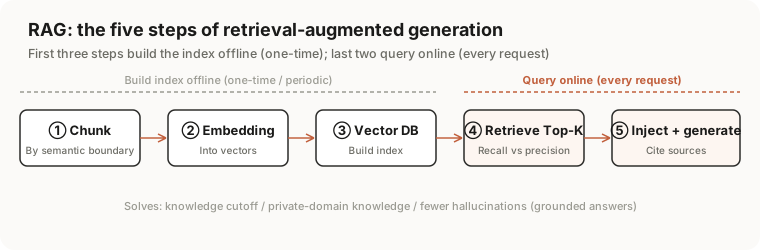
RAG (Retrieval-Augmented Generation) in one line: before generating, go fetch relevant content from an external knowledge base, stuff it into the context, and then let the model answer based on that content. It splits into two stages and five steps — the first three build the index offline, the last two run the query online:
| Step | Stage | What it does | Engineering key point |
|---|---|---|---|
| 1. Chunking | Offline | Cut long documents into small chunks | Chunk granularity: too large → imprecise retrieval, wasted budget; too small → broken semantics. Cutting on semantic boundaries (paragraphs/headings) beats hard-cutting on a fixed character count |
| 2. Embedding | Offline | Turn each chunk into a vector | Pick the right embedding model; for Chinese, test it empirically above all |
| 3. Store in vector DB | Offline | Store vectors + source text in a vector database | Build the index well, support fast similarity retrieval |
| 4. Retrieve Top-K | Online | Embed the query, fetch the k most similar chunks | Recall vs. precision: k too small misses key info, k too large pulls in noise and squeezes the budget; often paired with a rerank step |
| 5. Inject + generate | Online | Splice retrieved chunks into the prompt and hand them to the model along with the question | Injection budget: rank and truncate; citation traceability: mark which chunk each sentence came from, so it's traceable and verifiable |
RAG precisely solves three problems the model can't solve on its own: knowledge cutoff (let it read today's documents), private/domain knowledge (your expense handbook, codebase, product docs that the model has never seen), and reduced hallucination (answers grounded in evidence and required to cite sources, so the room to make things up gets squeezed).
Case: The Evolution of a Customer-Support Agent
Day 0 (nothing in place): a user asks, "How many team members does the Pro plan support?" The Agent guesses "10" from training data. Wrong — it's actually 5. The user complains.
Add RAG (solving the made-up answers): chunk the product docs, pricing page, and FAQ into the index. Ask again, and the Agent first retrieves the "Pro plan: 5 seats" chunk, injects it into context, and answers "5" with a source link attached. The hallucination is gone.
Add learning (solving starting from scratch): a longtime user keeps emphasizing, "I only care about API questions — skip the UI walkthroughs." The first time this is explicit feedback, and the Agent writes it into that user's long-term memory (path ②). After that it automatically recalls this preference and leads with API. Meanwhile, in the background, it notices that "answers about webhook retries" have a low copy rate and a high follow-up rate (implicit feedback); ops uses this to rewrite the docs and re-index them — another round of learning, this one happening on the RAG side.
RAG owns "knowing it right," learning owns "understanding you better and better": one manages knowledge correctness, the other manages strategy adaptation. Neither touches the weights; both work purely at the context layer — which is exactly why they can iterate fast and ship the same day.
Actionable Practices
Learning & Adaptation: ① exhaust in-context first, then consider memory, and only then touch fine-tuning; ② always capture explicit feedback and store it with high weight (a user actively correcting you is the most expensive signal); ③ design at least one implicit-feedback collector (pick one of copy rate / rewrite rate / follow-up rate and instrument it first); ④ memory must be recallable and forgettable (stale preferences need to be updatable and retirable); ⑤ advanced: automate the learning loop (let evaluation scores drive prompt rewrites, forming a closed loop).
RAG: ① chunk on semantic boundaries first, then tune the character count; ② retrieval quality comes before everything — evaluate it on its own (poor generation is eight-times-out-of-ten a retrieval miss, so unit-test recall first); ③ leave a budget for injection, rank and truncate (retrieving 20 chunks doesn't mean stuffing all of them in); ④ enforce citation traceability (squeezes hallucination + makes it debuggable); ⑤ for Chinese, you must empirically test the embedding and chunking (default configs are mostly tuned for English).
Meta-principle: both patterns are "change the context," not "change the model." When you want the Agent to be "smarter," your first instinct shouldn't be "swap in a bigger model" or "go fine-tune" — it should be "in the context I'm giving it, which piece of experience (learning) or which piece of knowledge (RAG) is missing?"
Weaving It Into the Course
Learning & Adaptation ↔ Module A's five layers, L4 Memory + the harness's autoevolve. Path ②, memory-driven adaptation, is exactly the implementation of layer L4 Memory in Module A's five layers — long-term memory isn't about storing data, it's about letting the Agent "remember how to do things." And autoevolve (automatic prompt evolution) in the harness methodology is essentially automating this "feedback → improve strategy" learning loop: letting evaluation results turn around and rewrite the prompt. Learning isn't a capability unique to models — engineering scaffolding can "learn" just as well.
RAG ↔ Module B's Context Engineering (the Cursor case study) + L4 in the five layers. RAG is the standard implementation of context engineering in the "external knowledge" dimension. Remember the codebase-index retrieval in the Cursor case study? Cursor chunks, embeds, and indexes the entire repo, and when you ask a question it first retrieves the relevant snippets and then injects them — that's a RAG built for code. Retrieved knowledge and long-term memory share the same L4 slot; the only difference is that memory stores "experience" and the RAG store holds "knowledge."
Wrap-Up
An Agent doesn't automatically get smarter because the model is bigger — it gets smarter because the context you give it is more correct. Learning & adaptation carry yesterday's lessons into today; RAG plugs the knowledge it never had right in front of it — neither touches the weights, both work at the context layer. So this lecture is the two most important downstreams of Module B's Context Engineering: one accrues experience internally, the other connects to knowledge externally.